Thursday, March 19, 2020

The Queen of Corona

If me and Julio can ever find it
in the schoolyard,
we’re gonna beat the crap
out of it and be on the cover of Newsweek.

Then we’re going to make 
a basketball out of it,
and let every good college and pro player
pound it on the floor for a whole month.

And then we’re gonna turn it 
to a hard rubber disk,
and give every pro hockey player
a chance to whack it with a wooden stick.

Of course we’ll also shape it
into a soccer ball,
and make sure every futbol pro in the world
kicks it with all their might.

Eventually we’ll reduce it to a ball with strings 
wrapped tightly in cowhide,
and give every major league baseball player 
a bat to hit it hard hundreds of feet.

And then we’ll chisel it down even further
to a little ball with dimples,
and ask every golf tournament pro
to tee off on it with an iron club.

For good measure we’ll ask thoroughbred horse jockeys
and mighty race car engine drivers,
to run over it again and again and just leave it behind
in a trail of muddy dirt and dust.

But we can’t.
We can only avoid it like a plague
until it begins to whither and die.
And then me and Julio will find it 
and kill it off once and for all.


Copyright Charles A. Bruns, 2020

Saturday, February 8, 2020

Concerts: hits and misses

A friend and former high school and college classmate recently shared some of her most memorable concert experiences on Facebook. It was very interesting to read, and got me thinking of some of my concert experiences:

First Concert(s) - When we lived in New York City, my mother would bring my brother and me to theaters where Spanish-language singers would perform in between movies. I don't recall any of their names, but they were good! In 1967, my stepfather and I saw Herb Alpert perform in a Central Park bandshell on a rainy night. My first rock 'n' roll show was The Rolling Stones concert during their six-night stand in June 1975 at Madison Square Garden in New York City. I'll always remember hearing the first chords of "Honky Tonk Women" as a five-pointed star containing individual members of the band opened up on stage.

Last Concert - Bob Dylan at the Beacon Theatre in New York the day after this past Thanksgiving, on November 29, 2019. At 78 years of age, he put on a great show for his fans, many of whom chanted "Let's go, Dylan!" before his encore, like New York Rangers fans at a Madison Square Garden hockey game.

Best Concert - David Byrne at Monmouth University in West Long Branch, New Jersey on September 7, 2018. I heard he put on a great show, but was simply blown away by the quality of the music and choreography. For weeks, I described the concert to family and friends as being like a Broadway show. Of course, it was: Less than 15 months later, David Byrne's American Utopia -- very similar to the show my wife and I saw at Monmouth -- had a four-month engagement at the Hudson Theatre on Broadway. You can see it until February 16!

Worst Concert - REM at the Capitol Theatre in Passaic, New Jersey, October 12, 1984. I liked the songs I heard on the radio from this up-and-coming band, who I read were on the verge of becoming rock 'n' roll geniuses. And they did indeed go on to great things. But they were a huge disappointment the only time I saw them in concert! Michael Stipe sang with his back to the audience much of the night and there was little energy coming from the band during the concert. Years later, I heard Stipe was very shy at that stage of his career.

Loudest Concert - THE RAMONES, HANDS DOWN! They were so loud at the Capitol Theatre in Passaic on February 10, 1979, that my girlfriend and I left before the concert ended because our ears were hurting. Seriously! I had a ringing sound in my ears for days, and it's a minor miracle I did not suffer permanent hearing damage because of that show. For years afterward, however, I did wear cotton in my ears to shows at the Capitol Theatre.

Seen The Most — I've seen Bob Dylan 19 times. Amazingly, I've seen him in 18 different venues, starting at the Hartford Coliseum on November 24, 1975. The only place I've seen Dylan twice in is the Beacon Theatre in New York City. And, if he returns there for another series of concerts around this Thanksgiving Day, I will see him a third time at the Beacon Theatre.

Next Concert - Probably one of the many free concerts in Long Branch's West End Park on a Sunday night or Pier Village on a Thursday night shortly after Memorial Day. My wife and I enjoy seeing as many of these shows as possible each summer and are fortunate we can just walk to them.

Most Fun Concert — This is the hardest of all to pinpoint. But I don't think the fun I had at a concert headlined by Yes in Roosevelt Stadium in Jersey City on July 25, 1975, was ever topped. It was one of the few shows in which the opening act, Ace (of "How Long Has This Been Going On" fame), was actually better than the main act. Of course, being able to enter the venue with friends carrying a spiked watermelon contributed to the fun! Tomorrow, however, I may remember a different concert that was even more fun.

Regret Not Seeing — Missing James Brown, Tito Puente, and Celia Cruz are my biggest regrets. My wife did get to see Celia in concert at the Tropicana Casino and Resort in Atlantic City on June 1, 2002, though, and told me all about it. And then there's Woodstock. I was working at a summer camp in upstate New York in August 1969 and signed up to go to the concert for a day with some camp counselors and other staff. They blew me off and went without me, however, because I was 5-10 years younger than most of them. We didn't see them back at the camp for days!

Thank you, Patrice Keegan, for inspiring me to share some of my concert hits and misses. I will always remember our trek to Hartford, Connecticut with friends in my Ford Thunderbird to see the Rolling Thunder Revue show with Bob Dylan, Joan Baez and cast that November night in 1975!


Sunday, January 5, 2020

Moving To The "Country"


Clockwise from top left: Charley's first communion portrait; wearing his Little League uniform; in front of former childhood home. 


a poem by Marshall S. Harth

Moving to Bloomfield, to the "Country"
Was like entering another country
Everything was not the same
I even had to change my name!
Why was that, because of shame?
Who's responsible, who to blame?
I missed my friends, my neighborhood
I had to lie, do what I could
Not my choice, only what I should
But, being me, I held my own
I recognized how I had grown
New vistas opened up to me
I saw, eventually, who I could be,
And that's the tale of my "Identity"!

Copyright Marshall S. Harth 18 October 2019

After reading my autobiographical account about moving from New York City to Bloomfield for a book project, my friend Marshall wrote this poem for me. A Jewish German/Lithuanian-American who was more fortunate than some of his family members who perished during the Holocaust, I am grateful to Marshall for understanding the twisting and turning journey of people's identities through immigration, separation, condemnation, and assimilation.

Monday, September 2, 2019

Morning Commuters

1.   The car commuter 

Start the new day with a quick coffee and bite.
Weather and traffic reports seem okay,
drive out of the neighborhood and to the highway.

From the car radio sounds “King of the Road.” 
The blank face smiles and then frowns,
wheels roll ever slowly and stop the commuter.


2.   The train commuter

The alarm sounds, the body rolls and rises.
The day’s preparations begin in a trance;
head to the station in a numb state.

A seat on the train, the voice of a conductor.
The whistle blows as the train rolls forward,
and back to sleep goes the commuter.


Copyright 2019, Charles A. Bruns

Saturday, June 29, 2019

The Friendly City: No Vacancy

a poem by Charley Bruns,
featuring lyrics by David CastaƱo of Eastbourne

Don’t try to impress me 
by saying George Washington slept there.
We had seven presidents stay here
on vacation away from Washington.
Their names were Grant, Hayes, Harrison, 
Garfield, Arthur, McKinley and Wilson.

These presidents put Long Branch on the map,
and the crowds from New York did come.
Soon so did others in their carriages,
four-legged and iron horses to soak up the sun,
enjoy the summer breezes, walk the bluffs and just have fun.

Did I mention the Atlantic Ocean?
Not too many cities 
can call an ocean their backyard.

Among the visitors were the wealthy 
industrialists and bankers and the Bohemians.
They gambled, they drank, they ate,
and eventually most found their way home late.
But many never returned.

Others who came in their wake did decide to stay,
and formed a year-round community 
that included a main street called Broadway,
complete with stores and theaters.

Long Branch got so big and diverse
with Jewish folk, African-Americans and Catholics,
even the Ku Klux Klan came to march downtown.
Fortunately, the door hit their asses on the way out.

The Mafia treated the city like a playground and more,
playing in the Surf Lounge and paying for
the construction of the Harbour Towers high-rise.
One little pussy of a mobster bragged
on the pages of Life magazine,

“What we got in Long Branch is everything.
Police we got. Councilmen we got, too.
We’re gonna make millions.”

Pussy Russo was eventually found dead
with three bullets in his head 
in a Long Branch spa while on furlough from prison,
because his bosses feared he would talk too much
in order to stay and enjoy the friendly city.

We had a native son and LBHS grad
who was named poet laureate
of the entire U.S. of A.
You can read his poem “Long Branch, New Jersey,”
on a plaque in Pinsky Park on Broadway.

The pier beckoned more visitors with its
amusement rides, arcades, bars.
There were hot dogs and other kinds of matter to put down,
which many people from across the state in fact did
as other shore towns south lured pleasure seekers
with their siren song of more, newer, better attractions.

The city eventually became symbolized by the Haunted Mansion,
with fake ghouls and real rats on its aging pier.
It continued creating memories for more locals
but fewer visitors before finally feeding the appetite
of a hungry fire that left behind charred splinters.

“My city is burning down down down,
and you’re not around.
You’re paying attention to some other town,
you missed us burn to the ground.”*

From the ashes rose the entirely new Pier Village,
with its fine restaurants, cafes, boutiques,
to attract people from all around,
but not the nostalgia of many locals, once again proving:

“You can please some of the people all of the time, 
you can please all of the people some of the time, 
but you can’t please all the people all of the time.”

Did Abraham Lincoln say that
while Mary Ann Todd was staying in Long Branch?
In any case, enough local citizens welcomed the change
and re-elected Mayor Schneider six times.

Today we have Brazilians and Mexicans 
and lots of other Latinos
calling the city home, with their restaurants 
and various businesses on Broadway,
which still has a performing arts theater
and now even a microbrewery.

We’ve been made by these broken streets,
and now we make all these broken beats.
But we just dig it and we just dig it,
but a keep on moving on.
That’s why we’re fighting, that’s why we’re fighting,
for where we belong.”*

We still have Jewish folk a-courting 
on the boardwalk Thursdays and Sundays,
and Italians and African-Americans like always.
The city even has a Sicilian-born poet laureate, 
whose voice rises above the tongues of people 
from all around the world on our boardwalk
and promenade every Fourth of July.

The ghosts of writers and artists past
smile at names like di Pasquale, CastaƱo and Delima now.
What can they say, except
“Wow, how cool is this Long Branch?”

“Come with the stylee if you want 
to come find Long Branch rhythm.
You gotta love the way the sky looks,
when everyone lets it bring them down.
And though the sun ain’t coming out,
I see light around my home town.”**

The Ink Well and Brighton Bar,
home of original music,
stand alongside the Celtic Cottage
and some new Brazilian businesses,
as a synagogue is built in West End,  
which isn’t actually in the west end.

Did I mention the Atlantic Ocean?
Not too many cities 
can call an ocean their backyard.

Long Branch is indeed a friendly city, 
with no vacancy for those 
who want to bring it back down
from where it rose.

“So when these ashes turn to gold,
and when these pages start to unfold,
I have seen the best of my city, 
because I’ve seen the worst of my city.”*


*Copyright 2016 by David CastaƱo, “Burning City” as recorded and performed by Eastbourne
**Copyright 2016 by David CastaƱo, “LB Stylee” as recorded and performed by Eastbourne

Poem copyright 2019 by Charles A. Bruns

Saturday, April 20, 2019

EspaƱa: 8 days in the past and present

I walked past them on the streets of Madrid, Barcelona and other cities in Spain. Many of them had my complexion, my eyes, my hair. Several of the faces bore the look my wife had become familiar with over the years. For sure, I was among my people. At the very least, I was among people whose distant ancestry I shared. No doubt, there were lots of them who had the same Lopez, Suarez, Castro and possibly ValdƩs surnames as my parents, grandparents and those in the previous generations of our family who migrated from Spain to Cuba 150-250 years ago. I never felt so comfortable, so at home, in a foreign land.

It took me over 60 years to visit Spain, but the eight-day trip I enjoyed there this spring made the wait worthwhile. My wife and I had an enlightening journey through the past and present in Madrid, Toledo, Cordoba, Sevilla, Granada, Valencia, Montserrat and Barcelona, surrounded by wonderful people, fascinating sights and plenty of great coffee and food.

When my wife and I arrived in Madrid, we stretched our legs with a walk past the Puerta de AlcalĆ” and Palacio de Communicaciones, just in time to see a parade of police officers marching from the Puerta del Sol to demand higher wages. We followed them to the Plaza de Neptuno, then continued past some government buildings (but not, apparently, the offices of El Ministerio del Tiempo) into the Parque del Buen Retiro. We got happily lost in the maze of the big park before eventually finding our way to the Monumento al rey Alfonso XII by the lake.

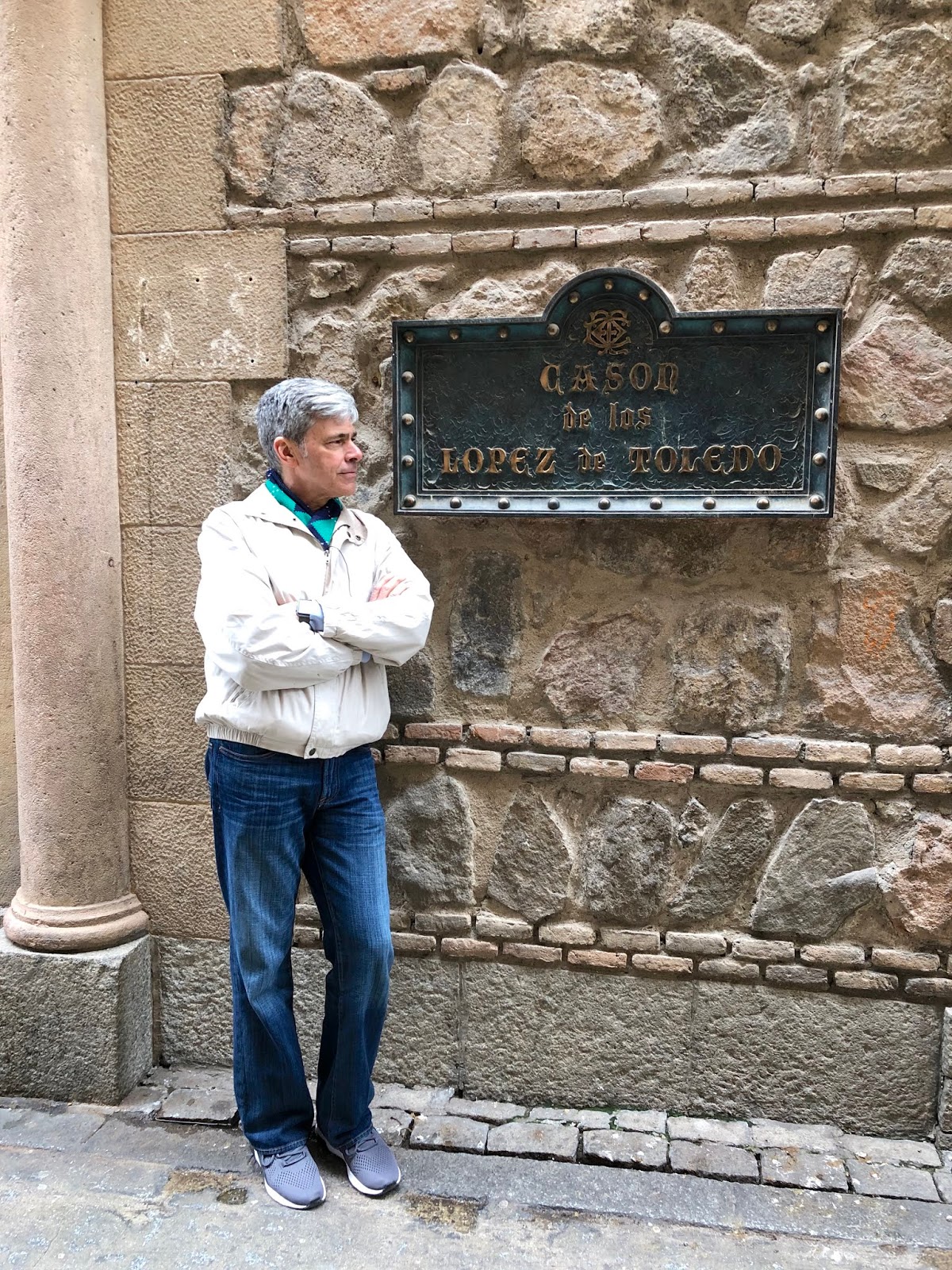
The next day, we joined our fellow Globus tourists on a ride past the Palacio Real, walk in the Plaza de EspaƱa with its monument to the author of Don Quixote, Miguel de Cervantes, and then spent a few -- too few -- hours at the Museo Nacional del Prado, where we were awed by original artworks from Diego Velazquez, Francisco de Goya, El Greco (Domenikos Theotokopoulos) and others. The highlight of the day, however, was an excursion to the old but well preserved city of Toledo, with its Catedral Primada Santa MarĆ­a and ancient concentration of Arab, Gothic, MudĆ©jar, Renaissance and Baroque architecture.

In Cordoba the following day, we visited the Mezquita-Catedral (also known as the Mosque of the Caliphs) and were struck again by the mix of Muslim and Christian architecture, including the city's Roman bridge. It was reassuring to know that at one time centuries ago Jews, Christians and Muslims actually lived together peacefully.

In Sevilla the next day, we visited its expansive Plaza de EspaƱa, the Casa de Pilatos, and spent time at Santa Iglesia Catedral, the largest Gothic cathedral in the world. My wife and I enjoyed walking around the neighborhood by the hotel and drinking another great cafe con leche (they seem readily available throughout the country). In the evening, we had dinner before watching a magnificent flamenco dance show at the El Palacio Andaluz.

La Alhambra, built in the 13th century as a city within the city of present-day Granada, was the highlight of the next day. It afforded us fabulous views of the  rest of Granada, where we saw the first of many caves in which some Spaniards continue living today with modern conveniences such as electricity and wi-fi.

The Mediterranean Sea city of Valencia was our next stop. Once again, we observed how well the Roman, Moorish and Spanish past of the city has been preserved. We were equally impressed, however, with the very modern Ciudad De Las Artes y Las Ciencias and its futuristic architecture. A major highlight of the visit to Valencia, no doubt, was dinner at a seaside restaurant in which three different paella dishes were served.

Our last stop in Spain was Barcelona, a city which words -- English, Spanish or local Catalan -- and pictures can't fully describe. We strolled around the El Gotic neighborhood and, in the evening, walked down the Gran Via Corts de les Catalans to join thousands of others at the Font Magico. We took in the site of the 1992 Olympics and La Barceloneta and waterfront areas that have been revitalized in recent decades, as well as Santa-Montjuic.

While visiting Barcelona, we also took an excursion to Montserrat, whose Royal Basilica houses the Virgin Morenita, a Romaneque carving whose hand can be touched by pilgrims. Montserrat, like other places we visited in Spain, offers breathtaking views.

What I'll remember most about Barcelona, however, is the one-of-a-kind Basilica de la Sagrada Familia, designed by Antoni Gaudi in the late 19th century and still under construction today. It is scheduled to be completed in 2026, on the 100th anniversary of Gaudi's death. Since I hope it won't be another 60-plus years before I return to Spain, I look forward to seeing the finished basilica with millions of Spaniards, people of Spanish ancestry, and others fascinated by the country's past and present history and culture!


To see some pictures from my journey through Spain, check out my Instagram page at: https://www.instagram.com/charleybruns/.


Born Charles Lopez to Cuban immigrants in New York City, Charley began using his stepfather's surname when he moved to New Jersey at 11 years of age. Charley also hopes to visit Cuba, where he spent a couple of his pre-school years, when the time is right.

Saturday, March 16, 2019

Lonely thoughts on a beach


When I last saw you
I thought I’d be back.
I didn’t think my good-bye
was so-long forever.

But here I sit on the beach,
looking beyond the cold ocean,
wondering where you are, 
how you’re doing,
if you still remember me.

I’m okay if you’re curious.
My studies were followed by jobs
and before you know it
I was practically American.

But I’m not quite all-American.
There’s no house with a white picket fence
or dogs running around a yard 
or a spouse with kids in my home.

Instead there are nights on WhatsApp,
Instagram, Facebook, Twitter,
with the TV on and bed unmade.
There are weekend days on the beach,
cold days, warm days, lonely days.

Yes, I got the education and career I wanted,
but I still don’t have you.
Will you be coming over any time soon?
Or should I came back for you?
Anyway, where are you?


copyright Charles A. Bruns, 2019