Showing posts with label Spain. Show all posts

Saturday, June 1, 2024

Las Islas Canarias

A word I found myself frequently using during my visit to the Canary Islands (referred to by local Spaniards as las Islas Canarias) this spring was “exotic.” Another word I used even more frequently was “wow.” There aren’t too many places in the world, after all, where ranges of mountains, some of them volcanic, and endless blue seas can be viewed at the same time. There are also few places where palm trees and cactus appear near each other.

But that’s just part of the allure of the Canary Islands.


Las Islas Canarias has a fascinating history and culture. Contrary to what many people may believe, the islands’ name is not derived from birds, but rather, from the presence of large dogs that early settlers observed. A species of birds on the island were subsequently referred to as canaries. 


The Canary Islands are believed to have been visited by many ancient civilizations, including the Romans, before Spaniards claimed most of it under their rule in the 15th century. Spain was able to repulse attacks from rival empires as well as pirates and other invaders for hundreds of years. After the failure of an independence movement in the mid-1970s, the Canary Islands remain a largely autonomous Spanish province today. Its people, architecture, and food are largely similar to those of Spain, but in an exotic tropical island setting near the northwest coast of Africa. Wow!


Of particular interest to me during my visit to the Tenerife and Gran Canaria isles was the large presence of  Cuban immigrants. I got to practice my Spanish language skills with taxi drivers, waitresses, and other locals in Costa Adeje, Las Palmas and neighboring areas who said they immigrated to the Canary Islands from Cuba during the past 5-20 years. The irony is that their families originally left the Canary Islands for Cuba approximately 70-100 years earlier for economic opportunities, and then returned to the Canary Islands for mostly the same reason. Some told me that other relatives chose to leave Cuba for Florida and New Jersey instead.  


On a personal level, it was wonderful for me to spend time in the Canary Islands since many of my distant ancestors are highly likely to have emigrated from there to Cuba, according to my 23andMe report. Some relatives have also told me this. I’m grateful my wife, our sons and their wives and granddaughter were able to enjoy being in such a special place with me. It was the best vacation I’ve ever had.


I was informed in advance by the only other American I know to have visited the Canary Islands that people from the United States are considered “exotic” by locals. He was right. One of the tour guides even asked if our boat got lost on its way from New York. She pointed out some of the many sights in the Canary Islands that made me say, “wow.”


I encourage more Americans to visit the Canary Islands. I certainly look forward to returning! 


To see a few more of the pictures I took while in the Canary Islands, click on the following of my Instagram posts:

May 15


May 16


May 17


May 18


Saturday, April 20, 2019

España: 8 days in the past and present

I walked past them on the streets of Madrid, Barcelona and other cities in Spain. Many of them had my complexion, my eyes, my hair. Several of the faces bore the look my wife had become familiar with over the years. For sure, I was among my people. At the very least, I was among people whose distant ancestry I shared. No doubt, there were lots of them who had the same Lopez, Suarez, Castro and possibly Valdés surnames as my parents, grandparents and those in the previous generations of our family who migrated from Spain to Cuba 150-250 years ago. I never felt so comfortable, so at home, in a foreign land.

It took me over 60 years to visit Spain, but the eight-day trip I enjoyed there this spring made the wait worthwhile. My wife and I had an enlightening journey through the past and present in Madrid, Toledo, Cordoba, Sevilla, Granada, Valencia, Montserrat and Barcelona, surrounded by wonderful people, fascinating sights and plenty of great coffee and food.

When my wife and I arrived in Madrid, we stretched our legs with a walk past the Puerta de Alcalá and Palacio de Communicaciones, just in time to see a parade of police officers marching from the Puerta del Sol to demand higher wages. We followed them to the Plaza de Neptuno, then continued past some government buildings (but not, apparently, the offices of El Ministerio del Tiempo) into the Parque del Buen Retiro. We got happily lost in the maze of the big park before eventually finding our way to the Monumento al rey Alfonso XII by the lake.

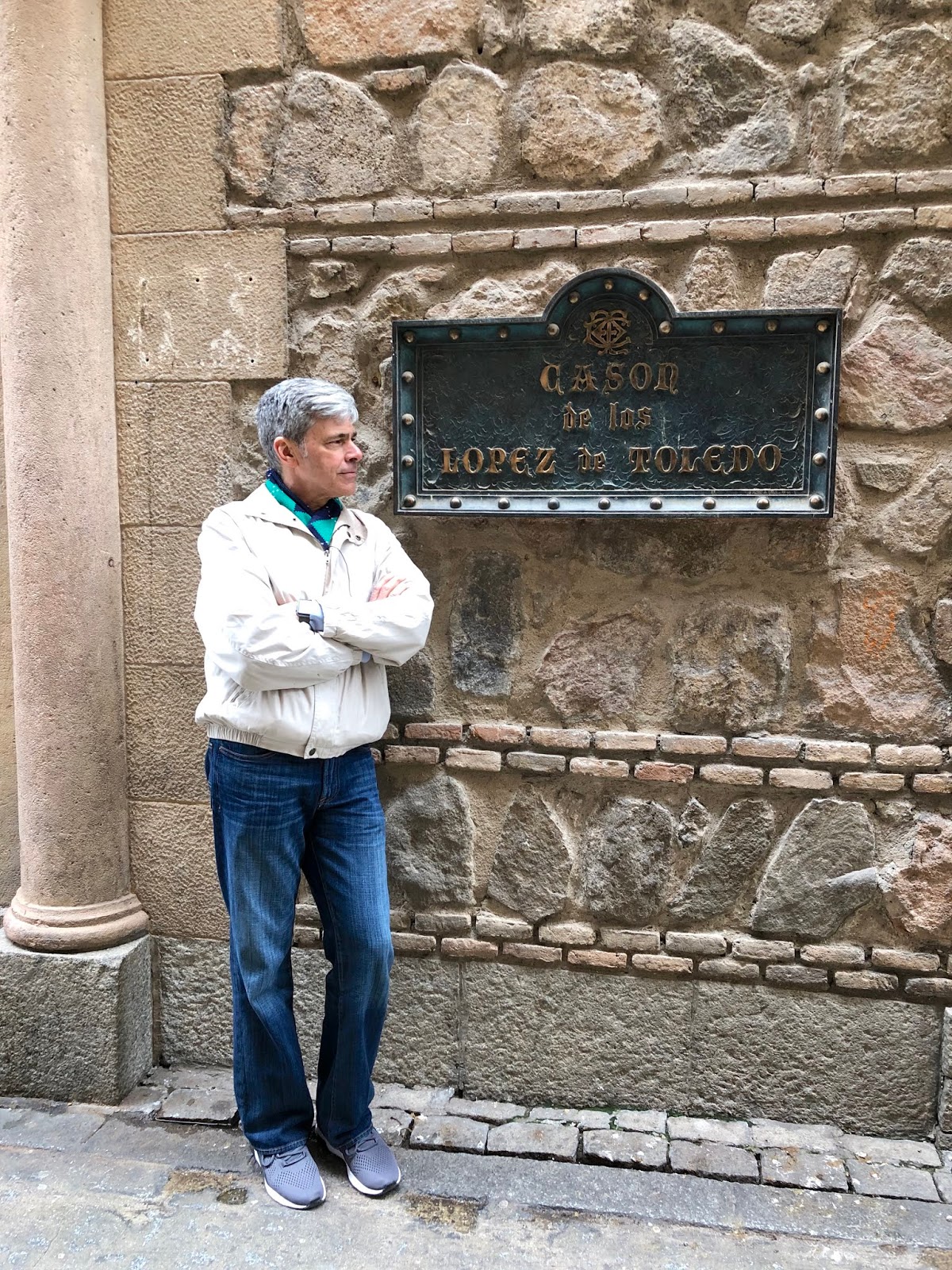
The next day, we joined our fellow Globus tourists on a ride past the Palacio Real, walk in the Plaza de España with its monument to the author of Don Quixote, Miguel de Cervantes, and then spent a few -- too few -- hours at the Museo Nacional del Prado, where we were awed by original artworks from Diego Velazquez, Francisco de Goya, El Greco (Domenikos Theotokopoulos) and others. The highlight of the day, however, was an excursion to the old but well preserved city of Toledo, with its Catedral Primada Santa María and ancient concentration of Arab, Gothic, Mudéjar, Renaissance and Baroque architecture.

In Cordoba the following day, we visited the Mezquita-Catedral (also known as the Mosque of the Caliphs) and were struck again by the mix of Muslim and Christian architecture, including the city's Roman bridge. It was reassuring to know that at one time centuries ago Jews, Christians and Muslims actually lived together peacefully.

In Sevilla the next day, we visited its expansive Plaza de España, the Casa de Pilatos, and spent time at Santa Iglesia Catedral, the largest Gothic cathedral in the world. My wife and I enjoyed walking around the neighborhood by the hotel and drinking another great cafe con leche (they seem readily available throughout the country). In the evening, we had dinner before watching a magnificent flamenco dance show at the El Palacio Andaluz.

La Alhambra, built in the 13th century as a city within the city of present-day Granada, was the highlight of the next day. It afforded us fabulous views of the  rest of Granada, where we saw the first of many caves in which some Spaniards continue living today with modern conveniences such as electricity and wi-fi.

The Mediterranean Sea city of Valencia was our next stop. Once again, we observed how well the Roman, Moorish and Spanish past of the city has been preserved. We were equally impressed, however, with the very modern Ciudad De Las Artes y Las Ciencias and its futuristic architecture. A major highlight of the visit to Valencia, no doubt, was dinner at a seaside restaurant in which three different paella dishes were served.

Our last stop in Spain was Barcelona, a city which words -- English, Spanish or local Catalan -- and pictures can't fully describe. We strolled around the El Gotic neighborhood and, in the evening, walked down the Gran Via Corts de les Catalans to join thousands of others at the Font Magico. We took in the site of the 1992 Olympics and La Barceloneta and waterfront areas that have been revitalized in recent decades, as well as Santa-Montjuic.

While visiting Barcelona, we also took an excursion to Montserrat, whose Royal Basilica houses the Virgin Morenita, a Romaneque carving whose hand can be touched by pilgrims. Montserrat, like other places we visited in Spain, offers breathtaking views.

What I'll remember most about Barcelona, however, is the one-of-a-kind Basilica de la Sagrada Familia, designed by Antoni Gaudi in the late 19th century and still under construction today. It is scheduled to be completed in 2026, on the 100th anniversary of Gaudi's death. Since I hope it won't be another 60-plus years before I return to Spain, I look forward to seeing the finished basilica with millions of Spaniards, people of Spanish ancestry, and others fascinated by the country's past and present history and culture!


To see some pictures from my journey through Spain, check out my Instagram page at: https://www.instagram.com/charleybruns/.


Born Charles Lopez to Cuban immigrants in New York City, Charley began using his stepfather's surname when he moved to New Jersey at 11 years of age. Charley also hopes to visit Cuba, where he spent a couple of his pre-school years, when the time is right.

Sunday, November 15, 2015

In awe of big brother


My brother and his wife, both newly retired albeit at a younger than normal age, recently completed a journey that most people a third of their age would find too challenging: they walked nearly 500 miles from St. Jean Pied-du-Port in western France across northeastern Spain over a span of 35 days. That's right, they walked, carrying nothing more than a backpack with all their essentials, for five weeks.

For sure, it wasn't easy. My brother Lou began the journey with pain in his right heel. He then caught a cold. Early in the walk, he also injured an ankle and rib. After a few weeks, blisters in his feet, he found himself feeling so foul that Andrea, his wife of 35 years, suggested they consider abandoning the second half of the walk. 

Lou and Andrea had planned their "Camino de Santiago" adventure for nearly two years, and trained for it on paths around North Carolina, where they've lived for 30 years. Lou's been a lifelong walker, starting in his native New York City and then while living in Bloomfield, New Jersey, and going on to serve in the U.S. Army. Even as he became diabetic and needed frequent insulin injections to regulate his blood sugar, he picked up his pace enough to run four full marathons, including the New York City Marathon in 1991. 

Andrea has also enjoyed walking and hiking her entire life. In fact, her and Lou's paths first crossed while hiking in the Grand Canyon. Three years later, they married. After he retired from teaching and she from nursing, it was only appropriate they begin their "golden years" with the kind of walk that rarely makes it beyond the bucket lists of most hikers. 

Even with his ailments, Lou was determined to complete the walk with Andrea. Fortunately, after nearly calling it quits, he began to feel better and stayed the course.  The two of them walked triumphantly, if not a bit wearily, into Santiago de Compostela a few weeks later, and ended their stay in Spain by spending several days in both Madrid and Barcelona.

I've always been in awe of my big brother.  Lou's successful completion of his long walk with Andrea this autumn reminds me how special a person he is and how much this little brother has to look up to.