Bruce Keenan, my boss when I was a part-time sportswriter at The Herald-News and completing my studies at Seton Hall University, was one of the most fascinating characters I’ve met in my life.
His first words to me, when I reported to work one winter evening in 1976 and introduced myself to him as he sat with a toothpick in his mouth and a yardstick protruding from the back of his shirt, were simple and direct: “Sit down.”
Yet, there was little simple about Bruce, I learned during my two years at the Passaic, NJ daily newspaper.
He was only in his mid-30s at the time, but he looked 15-20 years older despite not seeming to have a hard life. If anything, he was hard on life.
Bruce grew up in East Orange, NJ at a time when it changed from a largely white middle-class Newark suburb to mostly a community of African-Americans, whom he sometimes referred to as “rug heads.” He played basketball at Clifford J. Scott High School and went on to Bethany College, where he was as a sports editor for the Class of 1964 yearbook. After finishing military service (something he never talked about), he joined The Herald-News and established his credentials as a sportswriter chronicling the New York Mets miracle run to a World Series title in 1969.
By the time I joined The Herald-News in 1976, Bruce was editing the work of the newspaper’s sportswriters and collaborating with the backroom typesetters on the sports section’s layout. The yardstick he kept with him at all times, along with the lined papers that sat on his desk and the leather athletic shoes he wore on his feet, helped him accomplish that. The booze he liked to drink too often, unfortunately, did not.
When Bruce had one or two too many drinks, sometimes on dinner break when he was scheduled to work late, sometimes before he even got to the office, his staff would typically cover for him. One of the senior members would ensure the edits and layouts were properly done. The rest of us would turn it up a notch so that we could go home on time and with the sports section in good shape. If necessary, one of us would drive him home. It was my first lesson on the importance of taking good care of your boss.
Fortunately, Bruce usually took his job seriously and came to the office – almost always by foot – sober. He would often keep himself away from his local favorite bar (conveniently located halfway between his office and home) by bringing in a salad – “rabbit food,” he called it. After all the sports articles had been written, accounted for in the page layouts, and turned over to the typesetters, he would dismiss us and, shortly afterwards, unless he was “on the wagon,” finish his night by stopping at the bar on his way home.
To some, Bruce was a lot like Oscar Madison, the divorced sportswriter half of The Odd Couple. Bruce never married, though. And, he was a lot more interesting than the Oscar Madison character portrayed on the stage and screen.
For one thing, Bruce was not very predictable. Sometimes he was chatty and sociable and easily amused. Other times he was quiet and brooding.
He liked Bob Dylan, Waylon Jennings and Willie Nelson, and would sometimes blurt out a lyric from one of their songs. He said he disliked punk rock. When I went with him to CBGB in New York City one night, however, he felt completely in his element – and had a better time there a few months later during my farewell outing than most of the other, younger sportswriters.
Bruce could be generous, taking the staff out to dinner occasionally, although he basically was very thrifty and Spartan himself. He disliked cheapskates, referring to them as “five-and-dimers.”
He once moved out of his Clifton apartment when the landlord asked him to paint it. “I said ‘no,’” Bruce explained. “I’m not Picasso.”
Bruce appeared to have few friends outside of his favorite bar, but always seemed pleased by visits to the office from the Fairleigh Dickinson University sports information director, a former Herald-News sportswriter who a few years later would become the publicist of the New York Mets. Not surprisingly, the annual FDU sports banquet was Bruce’s favorite social event.
The only person Bruce seemed to spend any time with outside the office or bar was his mom (he never mentioned his father). Driving to visit her in East Orange appeared the only reason he had a car, a non-descript Renault that, like Bruce, seemed older than its years. To his credit, Bruce understood the perils of drinking and driving better than most contemporaries, and his car usually stayed parked in The Herald-News lot on Main Avenue while he walked to and from work.
I last saw Bruce about a dozen years after leaving The Herald-News, while running errands in downtown Clifton. He looked terrible, and the appearance of this big 50-year-old man going on 75 nearly frightened my young son.
It seemed all the sportswriters from my days at The Herald-News lost touch with Bruce as we moved on with our careers, and that was probably okay with him. Bruce seemed just fine with being left alone. He began his rest in peace on July 26, 1996, four months after turning 54.
I always felt one of my rewards for working at The Herald-News was having a boss like Bruce. I realized early in my career there are lessons about life, good and bad, that can’t necessarily be learned from written or spoken words but, rather, by simple observation and reflection. Perhaps that’s why Bruce told me to sit down when we first met.
Wednesday, August 10, 2011

Monday, August 8, 2011
The sportswriters
I’ve had the fortune of being in the right place at the right time during much of my life, especially in my professional career. This was never more true than the two years I spent working part-time as a sportswriter for The Herald-News in Passaic, NJ, while finishing my studies at Seton Hall University.
It was a time of technological transition in the newspaper industry. When I began at The Herald-News, articles were still composed on typewriters. By the time I left, we were inputting our stories on computer-like machines called video display terminals, or “tubes” as we called them.
During my time there, The Herald-News changed from a traditional broadsheet format, complete with an American flag in a top corner, to a radical easier-to-read horizontal-format design with lots of green color. Unlike computer technology, however, this change didn’t prove beneficial, and the newspaper reverted to a more traditional layout before merging with The News of Paterson in 1987 and, eventually, The Record of Bergen County.
Technology and design changes aside, what made my timing particularly good at “the product,” as we called it, was the interesting and gifted array of staffers I had the good fortune of working with. To an aspiring journalist, a paying gig at The Herald-News was a dream come true. The evening in January 1976 that I reported to work at the since-demolished Main Avenue office was one of the best in my life, despite a rather inauspicious start.
“Hi, I’m Charley Bruns,” I announced to my new boss as I held out my hand for him to shake. He looked up at me, tooth pick in his mouth and yardstick protruding from the back of his shirt, and replied, with some annoyance in his voice, “Sit down.” Fortunately, it got better when I proved that I belonged on his talented team.
Mike Moretti, a fellow Bloomfield resident and Seton Hall guy, recommended me to his bosses. A rising star and a cool cat among New Jersey sportswriters, Mike could make anything interesting to read. His written words had style, and years later he was described as “perhaps the most lovable sportswriter in the state” and, after a long career of contributing articles to The Star-Ledger about volleyball, bowling, track and field, girls lacrosse and sports memorabilia, “the utility man of the sportswriting set, the jack-of-all-trades.”
Equally talented and stylish with his written words was Hank Gola, on the verge of graduating Montclair State and launching a successful career which would land him at The Daily News of New York, where he covers the New York Giants and has been recognized as “by far and away the best golf writer of all the greater-NYC papers combined.”
When it came to sports knowledge, no one could top Jim Dente, who covered the New York Yankees when the Bronx Bombers of Reggie Jackson and Billy Martin regained the headlines and won a few championships. Jim’s probably working as hard as ever today as sports editor of The New Jersey Herald of Sussex County, and no doubt could still teach anyone more than a few things about sports and journalism.
Greg Schmalz also had an encyclopedic knowledge of sports, and would freely share it with a broadcaster-quality voice that years later helped him land assignments with ABC Radio. As The Herald-News reporter who travelled with New York Jets, Greg claimed to be pals with Joe Namath and even shared the legendary quarterback’s phone number, “212.555.1212,” with this gullible college kid.
When I started with The Herald-News, the biggest personality on the staff was Eric Mortenson, whose pen name was Kurt Ericson. A larger than life figure, Eric was the director of the Verona Recreation Center for 30 years while working part-time as a sportswriter.
Mark Everson and Jack Bell joined the sports department shortly after I began with The Herald-News. Mark’s baptism of fire was covering the New York Rangers, an assignment he took to so well that The New York Post hired him to do it for them years later. Today, he reports on the New Jersey Devils for the Post.
Jack had just graduated from the University of Wisconsin and, after a stint on the news desk, began covering the Cosmos with a knowledge of soccer that few American sportswriters could match. For the past 20 years, Jack has been a staff editor at The New York Times while continuing to write about soccer in blogs and columns.
Randy Lange and Pete Brophy also joined The Herald-News while I was there. Randy went on to cover the New York Jets for a dozen years, and today is editor-in-chief of newyorkjets.com as well as the team’s director of publications. I believe Pete, formerly The Press of Atlantic City digital editor, is now the newspaper’s local content editor.
Back in the day when women sportswriters were virtually unheard of, The Herald-News had Carol Sakowitz, who went on to write for various other newspapers and now may be the same Carol who is in Florida with The Charlotte Sun and Weekly Herald.
Two high school kids also launched their careers with The Herald-News during my time there. Barry Gramlich was a stylish teenager who went on to The Record of Bergen County, where he has been an editor and writer for 25 years. John Kobylt eventually found a niche in broadcasting and today is hugely successful in The John and Ken Show, a southern California program which is one of the most influential and listened to local talk radio shows in the United States.
Interestingly, the two college students who worked part-time in the sports department did not pursue sportswriting careers after graduating. While I used the wisdom gained from my experience at The Herald-News to launch a corporate communications career, Bill Mezzomo decided to go to Rutgers University School of Law and practice law in New Jersey. He is currently an associate with a Morristown law firm.
Not everyone who worked in The Herald-News sports department was a young stud, however. The eldest member of the staff was John Hayes, a former sportswriter with the Philadelphia Daily News. John was winding down his career in the mid-1970s and rarely had an assignment out of the office – but he was the only one of us guys who sported a goatee and an earring.
And then there was Bruce Keenan, our boss, The Boss before Bruce Springsteen laid claim to the title. He was the man who greeted me that January 1976 evening with a bit of indifference and skepticism. Bruce remains one of the most fascinating characters I’ve met in my life. Ah, but he’s the subject of another blog post.
It was a time of technological transition in the newspaper industry. When I began at The Herald-News, articles were still composed on typewriters. By the time I left, we were inputting our stories on computer-like machines called video display terminals, or “tubes” as we called them.
During my time there, The Herald-News changed from a traditional broadsheet format, complete with an American flag in a top corner, to a radical easier-to-read horizontal-format design with lots of green color. Unlike computer technology, however, this change didn’t prove beneficial, and the newspaper reverted to a more traditional layout before merging with The News of Paterson in 1987 and, eventually, The Record of Bergen County.
Technology and design changes aside, what made my timing particularly good at “the product,” as we called it, was the interesting and gifted array of staffers I had the good fortune of working with. To an aspiring journalist, a paying gig at The Herald-News was a dream come true. The evening in January 1976 that I reported to work at the since-demolished Main Avenue office was one of the best in my life, despite a rather inauspicious start.
“Hi, I’m Charley Bruns,” I announced to my new boss as I held out my hand for him to shake. He looked up at me, tooth pick in his mouth and yardstick protruding from the back of his shirt, and replied, with some annoyance in his voice, “Sit down.” Fortunately, it got better when I proved that I belonged on his talented team.
Mike Moretti, a fellow Bloomfield resident and Seton Hall guy, recommended me to his bosses. A rising star and a cool cat among New Jersey sportswriters, Mike could make anything interesting to read. His written words had style, and years later he was described as “perhaps the most lovable sportswriter in the state” and, after a long career of contributing articles to The Star-Ledger about volleyball, bowling, track and field, girls lacrosse and sports memorabilia, “the utility man of the sportswriting set, the jack-of-all-trades.”
Equally talented and stylish with his written words was Hank Gola, on the verge of graduating Montclair State and launching a successful career which would land him at The Daily News of New York, where he covers the New York Giants and has been recognized as “by far and away the best golf writer of all the greater-NYC papers combined.”
When it came to sports knowledge, no one could top Jim Dente, who covered the New York Yankees when the Bronx Bombers of Reggie Jackson and Billy Martin regained the headlines and won a few championships. Jim’s probably working as hard as ever today as sports editor of The New Jersey Herald of Sussex County, and no doubt could still teach anyone more than a few things about sports and journalism.
Greg Schmalz also had an encyclopedic knowledge of sports, and would freely share it with a broadcaster-quality voice that years later helped him land assignments with ABC Radio. As The Herald-News reporter who travelled with New York Jets, Greg claimed to be pals with Joe Namath and even shared the legendary quarterback’s phone number, “212.555.1212,” with this gullible college kid.
When I started with The Herald-News, the biggest personality on the staff was Eric Mortenson, whose pen name was Kurt Ericson. A larger than life figure, Eric was the director of the Verona Recreation Center for 30 years while working part-time as a sportswriter.
Mark Everson and Jack Bell joined the sports department shortly after I began with The Herald-News. Mark’s baptism of fire was covering the New York Rangers, an assignment he took to so well that The New York Post hired him to do it for them years later. Today, he reports on the New Jersey Devils for the Post.
Jack had just graduated from the University of Wisconsin and, after a stint on the news desk, began covering the Cosmos with a knowledge of soccer that few American sportswriters could match. For the past 20 years, Jack has been a staff editor at The New York Times while continuing to write about soccer in blogs and columns.
Randy Lange and Pete Brophy also joined The Herald-News while I was there. Randy went on to cover the New York Jets for a dozen years, and today is editor-in-chief of newyorkjets.com as well as the team’s director of publications. I believe Pete, formerly The Press of Atlantic City digital editor, is now the newspaper’s local content editor.
Back in the day when women sportswriters were virtually unheard of, The Herald-News had Carol Sakowitz, who went on to write for various other newspapers and now may be the same Carol who is in Florida with The Charlotte Sun and Weekly Herald.
Two high school kids also launched their careers with The Herald-News during my time there. Barry Gramlich was a stylish teenager who went on to The Record of Bergen County, where he has been an editor and writer for 25 years. John Kobylt eventually found a niche in broadcasting and today is hugely successful in The John and Ken Show, a southern California program which is one of the most influential and listened to local talk radio shows in the United States.
Interestingly, the two college students who worked part-time in the sports department did not pursue sportswriting careers after graduating. While I used the wisdom gained from my experience at The Herald-News to launch a corporate communications career, Bill Mezzomo decided to go to Rutgers University School of Law and practice law in New Jersey. He is currently an associate with a Morristown law firm.
Not everyone who worked in The Herald-News sports department was a young stud, however. The eldest member of the staff was John Hayes, a former sportswriter with the Philadelphia Daily News. John was winding down his career in the mid-1970s and rarely had an assignment out of the office – but he was the only one of us guys who sported a goatee and an earring.
And then there was Bruce Keenan, our boss, The Boss before Bruce Springsteen laid claim to the title. He was the man who greeted me that January 1976 evening with a bit of indifference and skepticism. Bruce remains one of the most fascinating characters I’ve met in my life. Ah, but he’s the subject of another blog post.
Sunday, June 19, 2011
Father’s Day self-portrait
Being a father has helped me become a much better person. For this, I want to thank my children.
It was only after the birth of my first son 24 years ago that I learned patience. When my second son entered the world four years later, I enhanced my multi-tasking skills so that each of my boys could feel how important they were to me.
Through raising my two sons, I’ve been reacquainted with appreciating the simple pleasures of life, like waiting for fish to bite a worm on a hook. I’ve experienced joys and other feelings I nearly forget about after growing up.
Fatherhood has taught me the nuances of baseball and soccer that can be passed on to young children, and how much fun it can be to get soaking wet running around a field with them. I’ve learned every rule of soccer, a knowledge that has enabled me to appreciate a match at any level more than ever.
By being a dad, I’ve learned to appreciate different kinds of music, be it jazz or classical or pop. I’ve learned how important a drummer is to the sound of a small band or big ensemble. I’ve even learned what it takes to pack, assemble and break down a drum set.
Being a father has enabled me to appreciate the value of trying different things, like wrestling or playing lacrosse, acoustic or bass guitar, blackjack, or performing in a school musical. I’ve also learned that it’s fine to move on from one activity to another after giving it an honest try, even after a significant investment in equipment or time.
I've learned to be less selfish by being a father because, when I looked around, I realized I was not the center of my universe. There were children who needed my time, my attention, my energy, and whatever else I could willingly share with them, day after day, in blocks of hours or, at least, minutes.
I’ve become less materialistic by being a father and seeing my children borrow my clothes and cars. I’ve learned that I actually own nothing in life. I’m merely in temporary possession of various items, a very liberating feeling, as is the knowledge that money has little value if you don’t have loved ones to share it with.
Love? I’ve felt a fuller, more meaningful sense of love by being a father, be it by changing a diaper, sitting through a late game or performance on a weeknight, providing comfort while watching a doctor stitch a cut, listening and providing support as a hope is born or vanishes...or, more often than not, simply by being in the same room with them.
More than anything, I’ve wanted to help my children in life by being a good father to them. I had no idea, however, that being a father would be so helpful in my own life. For this, I will always remain grateful to my children.

(photo) Kevin, Charley and Steven on Memorial Day weekend 2011
It was only after the birth of my first son 24 years ago that I learned patience. When my second son entered the world four years later, I enhanced my multi-tasking skills so that each of my boys could feel how important they were to me.
Through raising my two sons, I’ve been reacquainted with appreciating the simple pleasures of life, like waiting for fish to bite a worm on a hook. I’ve experienced joys and other feelings I nearly forget about after growing up.
Fatherhood has taught me the nuances of baseball and soccer that can be passed on to young children, and how much fun it can be to get soaking wet running around a field with them. I’ve learned every rule of soccer, a knowledge that has enabled me to appreciate a match at any level more than ever.
By being a dad, I’ve learned to appreciate different kinds of music, be it jazz or classical or pop. I’ve learned how important a drummer is to the sound of a small band or big ensemble. I’ve even learned what it takes to pack, assemble and break down a drum set.
Being a father has enabled me to appreciate the value of trying different things, like wrestling or playing lacrosse, acoustic or bass guitar, blackjack, or performing in a school musical. I’ve also learned that it’s fine to move on from one activity to another after giving it an honest try, even after a significant investment in equipment or time.
I've learned to be less selfish by being a father because, when I looked around, I realized I was not the center of my universe. There were children who needed my time, my attention, my energy, and whatever else I could willingly share with them, day after day, in blocks of hours or, at least, minutes.
I’ve become less materialistic by being a father and seeing my children borrow my clothes and cars. I’ve learned that I actually own nothing in life. I’m merely in temporary possession of various items, a very liberating feeling, as is the knowledge that money has little value if you don’t have loved ones to share it with.
Love? I’ve felt a fuller, more meaningful sense of love by being a father, be it by changing a diaper, sitting through a late game or performance on a weeknight, providing comfort while watching a doctor stitch a cut, listening and providing support as a hope is born or vanishes...or, more often than not, simply by being in the same room with them.
More than anything, I’ve wanted to help my children in life by being a good father to them. I had no idea, however, that being a father would be so helpful in my own life. For this, I will always remain grateful to my children.

(photo) Kevin, Charley and Steven on Memorial Day weekend 2011
Sunday, June 5, 2011
Neighbors
If you’re in New York City for any period of time, you’re bound to come across some interesting characters. If you live in the city, like I did for much of my childhood, some of these people will even be neighbors.
When I lived in the Amsterdam Houses neighborhood for much of the 1960s, Fermin and Carmen lived in the apartment next door with five children, the two youngest of which were theirs, the oldest three hers from a previous marriage. I’m not sure how Fermin made his livelihood, but I did see him walk on Amsterdam Avenue more than once with a parrot perched on his shoulder. He also boxed, which together with his goatee and penetrating eyes and sly smile, made him seem both a cool and tough Puerto Rican.
Carmen and my mother conspired on Christmas Eves to help keep my brother and me believing Santa Claus would arrive at out apartment only after we fell asleep. As we approached our apartment door after dinner at my Abuela’s, Carmen would open her door and say that Santa Claus had not yet arrived, so we needed to get to bed as soon as possible. She was right – there were no gifts under our Christmas tree that night, but they were there the next morning.
Carmen’s oldest three kids were called Papo, Moosie, and Choocho. At least, that’s what everyone called them. Papo’s real name was Cristobal, and he had the best baseball glove, a Maury Wills model, of anyone I knew. He was nice enough to let me use it sometimes.
On the opposite side of our apartment lived the Harts, an African-American family whose members I never recall smiling. I rarely talked to them; they seemed very serious all the time. Mr. Hart and one or both of his sons sometimes stared out the hallway window with what seemed like tan-colored stockings on their skulls. It seemed unusual to me, so I once out of curiosity asked them about it. They explained it helped relieve their headaches.
I can only recall speaking to Mrs. Hart once. She rang our doorbell one afternoon collecting donations for the March of Dimes. I quickly looked around our apartment for all the dimes I could find, and I gave her a few. She still didn’t smile, but I’m sure she said “thank you.”
I don’t know who lived directly upstairs from me, but I know they loved Latin music. Many times, when my brother and I laid down to sleep, we would hear the sounds of Tito Puente and other Latin artists blare from the record player above our bedroom. It sounded good, and we often fell asleep with those beats in our head.
In those days well before Facebook and inexpensive phone calls, our family lost touch with these neighbors shortly after moving to New Jersey. But, they’re not forgotten.
When I lived in the Amsterdam Houses neighborhood for much of the 1960s, Fermin and Carmen lived in the apartment next door with five children, the two youngest of which were theirs, the oldest three hers from a previous marriage. I’m not sure how Fermin made his livelihood, but I did see him walk on Amsterdam Avenue more than once with a parrot perched on his shoulder. He also boxed, which together with his goatee and penetrating eyes and sly smile, made him seem both a cool and tough Puerto Rican.
Carmen and my mother conspired on Christmas Eves to help keep my brother and me believing Santa Claus would arrive at out apartment only after we fell asleep. As we approached our apartment door after dinner at my Abuela’s, Carmen would open her door and say that Santa Claus had not yet arrived, so we needed to get to bed as soon as possible. She was right – there were no gifts under our Christmas tree that night, but they were there the next morning.
Carmen’s oldest three kids were called Papo, Moosie, and Choocho. At least, that’s what everyone called them. Papo’s real name was Cristobal, and he had the best baseball glove, a Maury Wills model, of anyone I knew. He was nice enough to let me use it sometimes.
On the opposite side of our apartment lived the Harts, an African-American family whose members I never recall smiling. I rarely talked to them; they seemed very serious all the time. Mr. Hart and one or both of his sons sometimes stared out the hallway window with what seemed like tan-colored stockings on their skulls. It seemed unusual to me, so I once out of curiosity asked them about it. They explained it helped relieve their headaches.
I can only recall speaking to Mrs. Hart once. She rang our doorbell one afternoon collecting donations for the March of Dimes. I quickly looked around our apartment for all the dimes I could find, and I gave her a few. She still didn’t smile, but I’m sure she said “thank you.”
I don’t know who lived directly upstairs from me, but I know they loved Latin music. Many times, when my brother and I laid down to sleep, we would hear the sounds of Tito Puente and other Latin artists blare from the record player above our bedroom. It sounded good, and we often fell asleep with those beats in our head.
In those days well before Facebook and inexpensive phone calls, our family lost touch with these neighbors shortly after moving to New Jersey. But, they’re not forgotten.
Tuesday, April 26, 2011
Garland Jeffreys, Coney Island and me
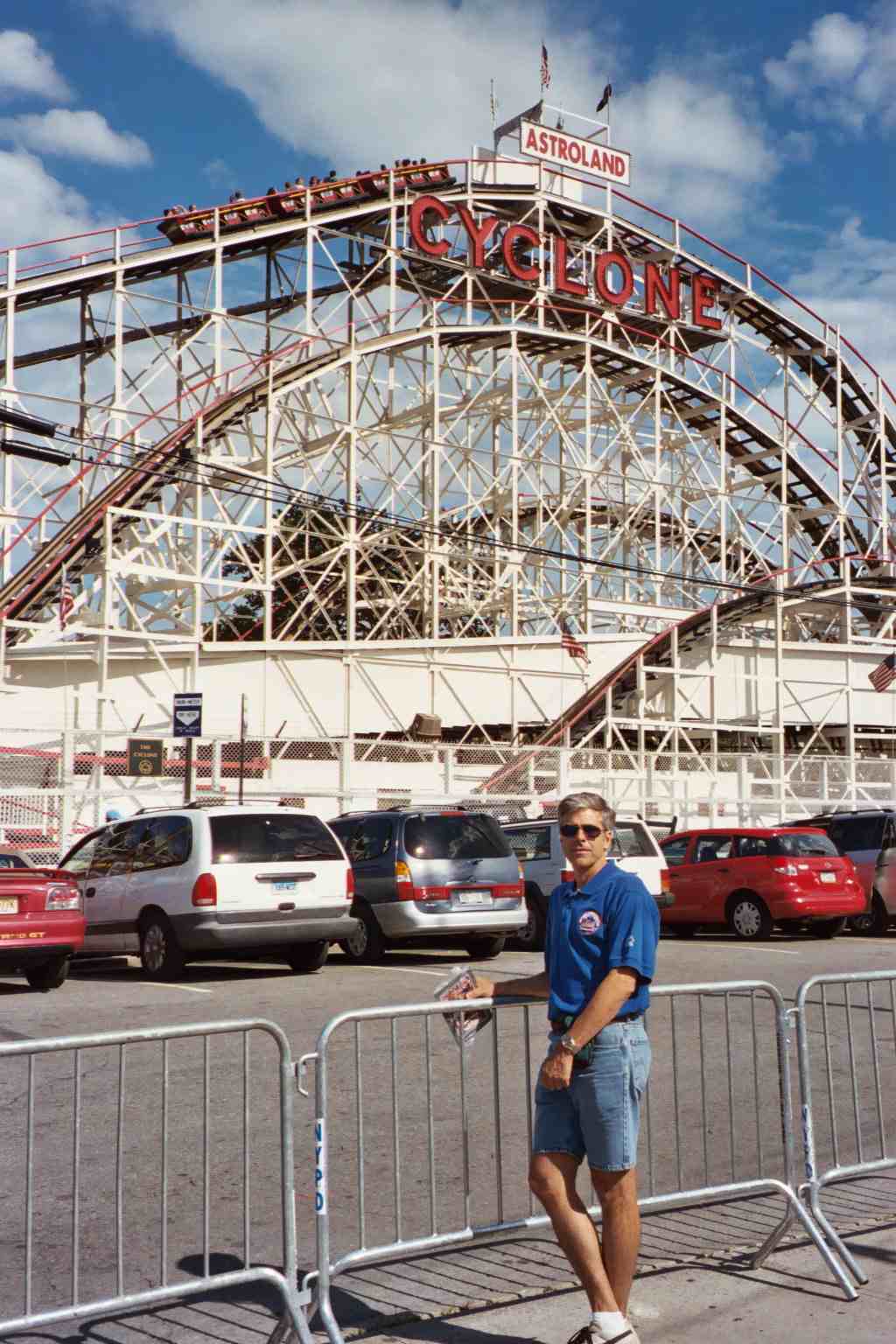

Perhaps it’s no coincidence that I heard the first song, “Coney Island Winter,” from Garland Jeffreys' upcoming disc on WXPN-FM only days after reading the news that Coney Island’s new Scream Zone was opening to the public. The Brooklyn-based musician and amusement park have intersected with my life at many points. Why not with each other this time, as they introduce something new?
Just two months ago, I saw Garland Jeffreys entertain his fans at a concert in Moorestown, NJ (that’s a picture of Garland and me after the show). He sounded great as he sang from his heart. We left appreciating what a kind and giving guy he is, and what a talented musician he remains.
Garland Jeffreys’ album, Escape Artist, was one of my soundtracks for the summer of 1981. My wife and I were newly wed, and his record spun on our turntable dozens of times those hot months. I can still almost hear “Modern Lovers,” “96 Tears,” “R.O.C.K.” and others songs from that album in the two-family house we shared with another newly wed couple. In fact, that music helped facilitate the formation of a great friendship.
Almost 25 years later, one of those friends mentioned to me that Garland Jeffreys had played a “house concert” in northern New Jersey. It introduced us to the concept of house concerts, where a few dozen fans see an artist perform in someone’s living room for a very reasonable price and have the chance to meet them.
Garland Jeffreys grew up in Brooklyn, NY, which he still calls home. The Sheepshead Bay neighborhood of his youth was only a short distance from Coney Island, which also was a significant part of my New York City childhood. After sunny summer days at nearby Brighton Beach, our family would often go over to Coney Island to eat at Nathan’s, ride the Wonder Wheel, the carousel where I could lean over and grab some token rings and, when I was a bit older, ride the Cyclone.
I remember going to Coney Island for my 10th birthday. As seedy as the place had gotten by the mid-1960s, it was still special to me and other New Yorkers. Even after moving to New Jersey, I never went too long without returning to Coney Island.
In the mid-1980s, driving back from business meetings in Long Island, I talked a couple of co-workers into going there just to ride the Cyclone. After my cousin’s high school graduation party -- in Sheepshead Bay – in 2002, my wife and parents walked around there with me for old-time’s sake. Five years later, my youngest son and I enjoyed ourselves there for a few hours before a Brooklyn Cyclones baseball game in the shadows of the long-closed Parachute Jump.
Two summers ago, my big brother and I made Coney Island part of a weekend romp through the city. It reminded us how much we enjoyed the long subway train ride from Manhattan through Brooklyn…but also made us realize that our bones had gotten too old for the bumpy thrills of the Cyclone roller coaster.
Don’t bother telling Garland Jeffreys he’s too old to be making good music. The Brooklyn man’s concert performance and new song indicate he still has the heart and mind of a young artist.
And, don’t tell that parcel of Brooklyn land, Coney Island, to sink into the Atlantic Ocean with the ghosts of its past. Scream Zone, the new Luna Park that opened two years ago, and the oldies-but-goodies Cyclone and Wonder Wheel indicate it still has some fun to share with New Yorkers.
To see some old and new Coney Island footage, go to www.garlandjeffreys.com and click on the video for “Coney Island Winter.”
Wednesday, March 16, 2011
Peakin’ at the Beacon with the Allman Brothers Band
Minutes before the Allman Brothers Band concert began on Tuesday, a local disc jockey came on stage and said to the audience, “You’re not a real New Yorker until you’ve seen the Allman Brothers Band here at the Beacon Theatre!” Well, even though my birth certificate states I was born in the city many years ago, I guess I’m officially a New Yorker now. In the process, I checked off another activity from my bucket list.
The Allman Brothers Band would never be confused for New York rock 'n' rollers, but this band from the south owe some of their success to the city thanks to the popularity of their “Live at the Fillmore East” album 40 years ago. They’ve shown their gratitude, and good business acumen, by playing lots of shows over a few weeks around March at the Beacon Theatre for 20 of the past 22 years.
Tuesday’s concert had some of the spirit I imagined was present during the historic Fillmore East show. A video screen at the back of the stage displaying psychedelic images helped the audience get that feeling. In the balcony by me, a heavy and heavily-tattooed woman alternated sips from a Southern Comfort pint and cola bottle for some extra help. Also nearby, two middle-aged men lit something that let off a pungent odor, then laughed and observed they were closer to the ceiling than the stage – which they seemed, literally and figuratively.
Old and middle-aged, actually, were the dominant demographic at the concert. All seemed happy to be there, and many have probably seen the Allman Brothers Band several times over the years, if not during the current Beacon run. Some just looked like survivors which, come to think of it, is more than can be said of some of their 1970s contemporaries and original members of the Allman Brothers Band.
The music? It was fine. Gregg Allman’s vocals remain gritty and powerful. The guitar playing of Derek Trucks and Warren Haynes are superb and true to the band’s roots, and Butch Trucks is still masterful behind the drums. At times, the fans went wild. I don’t think, however, my sons would’ve been among them. In an immodest moment, my 24-year-old -- a music conservatory graduate -- would probably say he is as good as one or two of the Allman Brothers Band’s three percussionists. My 20-year-old would probably say Ben Folds, who played at the Beacon in December, puts on a better show. I admit I would agree with both of them.
A young woman (one of the few in the audience) from Colorado sitting next to my wife might disagree. Saying she had seen the Allman Brothers Band about 10 times, she was in New York for a seminar and seemed very happy to take advantage of a chance to be at the Beacon Theatre concert.
Perhaps I would’ve been knocked out if I was able to stay long enough to see Eric Clapton join the band on stage. As a concession to living in the suburbs, however, I had to bail in order to catch a New Jersey Transit train home or risk being stranded in the city. It being a weeknight, my wife and I needed to get some sleep and wake up early enough to give our employers an honest day’s work on Wednesday. I should’ve known that an Allman Brothers Band concert advertised to start at 8:00 would not be nearly over by 11:00.
As I left, I noticed several middle-aged women and some male contemporaries drinking at the bar inside the theatre entrance. I guess they also weren’t knocked out by the concert, but at least I was grateful to enjoy it while I was there.
The Allman Brothers Band would never be confused for New York rock 'n' rollers, but this band from the south owe some of their success to the city thanks to the popularity of their “Live at the Fillmore East” album 40 years ago. They’ve shown their gratitude, and good business acumen, by playing lots of shows over a few weeks around March at the Beacon Theatre for 20 of the past 22 years.
Tuesday’s concert had some of the spirit I imagined was present during the historic Fillmore East show. A video screen at the back of the stage displaying psychedelic images helped the audience get that feeling. In the balcony by me, a heavy and heavily-tattooed woman alternated sips from a Southern Comfort pint and cola bottle for some extra help. Also nearby, two middle-aged men lit something that let off a pungent odor, then laughed and observed they were closer to the ceiling than the stage – which they seemed, literally and figuratively.
Old and middle-aged, actually, were the dominant demographic at the concert. All seemed happy to be there, and many have probably seen the Allman Brothers Band several times over the years, if not during the current Beacon run. Some just looked like survivors which, come to think of it, is more than can be said of some of their 1970s contemporaries and original members of the Allman Brothers Band.
The music? It was fine. Gregg Allman’s vocals remain gritty and powerful. The guitar playing of Derek Trucks and Warren Haynes are superb and true to the band’s roots, and Butch Trucks is still masterful behind the drums. At times, the fans went wild. I don’t think, however, my sons would’ve been among them. In an immodest moment, my 24-year-old -- a music conservatory graduate -- would probably say he is as good as one or two of the Allman Brothers Band’s three percussionists. My 20-year-old would probably say Ben Folds, who played at the Beacon in December, puts on a better show. I admit I would agree with both of them.
A young woman (one of the few in the audience) from Colorado sitting next to my wife might disagree. Saying she had seen the Allman Brothers Band about 10 times, she was in New York for a seminar and seemed very happy to take advantage of a chance to be at the Beacon Theatre concert.
Perhaps I would’ve been knocked out if I was able to stay long enough to see Eric Clapton join the band on stage. As a concession to living in the suburbs, however, I had to bail in order to catch a New Jersey Transit train home or risk being stranded in the city. It being a weeknight, my wife and I needed to get some sleep and wake up early enough to give our employers an honest day’s work on Wednesday. I should’ve known that an Allman Brothers Band concert advertised to start at 8:00 would not be nearly over by 11:00.
As I left, I noticed several middle-aged women and some male contemporaries drinking at the bar inside the theatre entrance. I guess they also weren’t knocked out by the concert, but at least I was grateful to enjoy it while I was there.
Saturday, March 5, 2011
Irony in FIFA's home town
Walking through Zurich's Old Town this Saturday, I came across a crowd of people, some kicking soccer balls, some drinking beers, some wearing blue and white jerseys, some with blue and white scarves. It looked interesting enough, so I wandered over and asked someone, "Sprechen sie Englisch?" "No," he replied. I found someone else who replied with some pause, "No -- but he does," and proceeded to learn what was going on from his friend.
It turned out that a group of Grasshopper Club Zurich soccer fans had assembled to rally for a new stadium a few hours before that evening's home match. Their club, the oldest in Zurich and most successful in Swiss soccer history, has been sharing the 25,000-capacity stadium -- about the size of one-year-old Red Bull Arena in Harrison, NJ -- of their local archrivals, FC Zurich, for the past four seasons. A new stadium was planned at the site of the old stadium when it was demolished, but it appears the project has stalled. Clearly, Grasshopper CZ fans are not happy about this and were voicing their displeasure before marching 30 minutes to see their favorite team play.
It's ironic that, four months after Zurich-based FIFA awarded the 2018 and 2022 World Cup tournaments to oil-rich Russia and Qatar, the two most popular soccer clubs in its own back yard appear in an uncomfortable stadium sharing situation. Russia has 13 stadiums to build or reconstruct in order to host the World Cup in seven years, and Qatar has to build 12 stadiums from scratch in order to host the World Cup four years later.
Quatar was controversially awarded the World Cup with a bid that promised, among other far-fetched ideas, to dismantle and reassemble its World Cup stadiums in other parts of the world needing them. Did the Qatar World Cup bid organizers have Zurich, not exactly an underdeveloped part of the world, in mind? Surely not. But the irony shouldn't be lost on FIFA's executives. That's assuming, of course, that FIFA's leadership even knows what's going on in their home town -- probably as far-fetched an idea as Qatar's to air condition all their new (outdoor) stadiums (if not the entire country) and then give them away!
It turned out that a group of Grasshopper Club Zurich soccer fans had assembled to rally for a new stadium a few hours before that evening's home match. Their club, the oldest in Zurich and most successful in Swiss soccer history, has been sharing the 25,000-capacity stadium -- about the size of one-year-old Red Bull Arena in Harrison, NJ -- of their local archrivals, FC Zurich, for the past four seasons. A new stadium was planned at the site of the old stadium when it was demolished, but it appears the project has stalled. Clearly, Grasshopper CZ fans are not happy about this and were voicing their displeasure before marching 30 minutes to see their favorite team play.
It's ironic that, four months after Zurich-based FIFA awarded the 2018 and 2022 World Cup tournaments to oil-rich Russia and Qatar, the two most popular soccer clubs in its own back yard appear in an uncomfortable stadium sharing situation. Russia has 13 stadiums to build or reconstruct in order to host the World Cup in seven years, and Qatar has to build 12 stadiums from scratch in order to host the World Cup four years later.
Quatar was controversially awarded the World Cup with a bid that promised, among other far-fetched ideas, to dismantle and reassemble its World Cup stadiums in other parts of the world needing them. Did the Qatar World Cup bid organizers have Zurich, not exactly an underdeveloped part of the world, in mind? Surely not. But the irony shouldn't be lost on FIFA's executives. That's assuming, of course, that FIFA's leadership even knows what's going on in their home town -- probably as far-fetched an idea as Qatar's to air condition all their new (outdoor) stadiums (if not the entire country) and then give them away!
Subscribe to:
Posts (Atom)
