Leave it to Ray Davies to take on an autobiography as a creative challenge. Twice.
Rather than give his fans a chronological account of facts and anecdotes about his life, the former singer and songwriter of the Kinks has twice chosen a different approach. Almost 20 years ago, he authored X-Ray, which can be described as a semi-fictional autobiography. Late last year, he released Americana, which presents the British star's experience in the United States. Of course, they are both great reads.
In Americana, Davies explains the influence US music and films had on his artistic development as a child in suburban London. He goes on to describe the Kinks first US tour in 1965, on the heels of the British Invasion, and their comeback tour in the fall of 1969. Comeback from what, you might ask, since the Kinks continued recording and releasing good music in the intervening years?
Davies' mind, now almost 70 years old, isn't quite so sharp on this point. At various points in Americana, he writes he doesn't know why the Kinks were banned from performing in the US for four years in the late 1960s. Near the end of the book, however, he indicates it was probably because of an issue with a concert promoter.
Davies goes on to describe how important the US music market was for the Kinks as the band continued evolving during the 1970s, switching labels and management and, by the 1980s, playing venues as large as Madison Square Garden. He recalls forcing Bill Graham to keep his word when the Kinks took the stage in front of hundreds of thousands of people at the US Festival in San Bernardino in 1982.
Davies also writes with pride about being inducted into the Rock and Roll Hall of Fame and playing at its inaugural concert at Cleveland Stadium in 1995 -- which turned out to be the final Kinks concert in the US. Davies did return as a solo performer 10 years later, reading excerpts from his X-Ray autobiography and playing stripped-down versions of Kinks songs. I was fortunate to catch him at the McCarter Theater in Princeton in 1997.
A significant part of Americana, however, centers around New Orleans. Specifically, Davies writes much about his experiences in this unique US city, including the shooting which almost ended his life in January of 2004. It's these passages about New Orleans, which break up the chronological order in which he presents his American experience, which are the most telling. They're a ray of light into his mind and soul, with a poignancy about his life, the muse he followed, the ambitions he harbored, the relationships he valued, not stated elsewhere in his writings, but understood and appreciated by Davies' fans. He also provides new insights into the unique lure of New Orleans.
Reading Americana had me thinking about the times I saw the Kinks in concert. In late July of 1979, they played a great show at the Asbury Park Convention Hall, a venue for a 1977 performance Davies describes "like playing Southend-on-Sea at an English seaside resort. Great audience; say no more.”
In July of 1987, the Kinks played one of the last concerts at the Capitol Theatre in Passaic, New Jersey, located in a part of town in which one or two old movie theaters screened pornography, which was also accessible from surrounding shops. Davies introduced a new Kinks song, "Welcome to Sleazy Town," by alluding to these facts.
Having played at the Capitol Theatre at least five other times since 1972, I'm sure Davies was familiar with Passaic, where I also saw Elvis Costello, the Ramones, Patti Smith Group, the Who, Joe Jackson, the Clash, Pretenders, Adam and the Ants, Missing Persons, the Thompson Twins, REM and others. British or American, it's questionable if anyone from these acts can write about their experiences on these shores like Ray Davies -- who has inspired many of them in the nearly 50 years since the Kinks first landed at Kennedy Airport.
Will Davies ever pen a conventional autobiography? If so, would it be as interesting as X-Ray or Americana? A definite maybe...you really got me...he's one to give the people what they want...not just a face in the crowd...but already a well respected man...one of the survivors...a 20th century man...killing time...hoping for better things...as his life goes on.
Wednesday, February 26, 2014
Monday, February 3, 2014
A businessman as an artist and scientist
When he was a graduate student at the University of Pennsylvania Wharton School, Herman Mihalich wrote a business plan for a microbrewery. After graduating, he embarked on a successful career in the specialty chemicals industry. Over the years, he observed the rise in popularity of craft beers and sometimes wondered: What would have happened if I implemented my business plan for a microbrewery?
Three years ago, Herman wrote a business plan for a small batch whiskey distillery. He found a business partner, lined up a group of investors, and located a site in Bristol, Pennsylvania, to base the operation. Today, Dad's Hat Pennsylvania Rye Whiskey can be purchased in liquor stores and taverns.
When I last saw Herman before this winter, he was an executive at the U.S. headquarters of a large global specialty chemicals company. His Ivy League education, strong work ethic and direct approach to meeting challenges served him well. His considerable skills and future potential had been recognized early in his career, and he spent five years at the company's Paris headquarters before returning to New Jersey to assume a series of increasingly important positions.
Herman seized an opportunity to join another major specialty chemicals company in an executive role in 2006. After three years, however, organizational changes there put him in a situation familiar to many middle-aged corporate executives in the U.S. today. At a crossroad, he weighed his options and decided the time was right to pursue opening a craft whiskey distillery in Pennsylvania, the state where he was born and spent his childhood living above his family's tavern in Monessen.
"Making whiskey is part art and part science," Herman explained when I visited him at the Bristol distillery on a cold late January afternoon. "My experience as a chemical engineer has come in quite handy."
Herman and his business partner, John Cooper, roll up their sleeves to handle every aspect of their operation each week, from obtaining the raw ingredients, barrels and other supplies, to mixing and controlling the quality of each batch and marketing the bottles to distributors. In less than two years, the business became cash positive. Favorable reviews of the distillery's whiskey products have poured in from trade publications and other liquor experts.
Dad's Hat Pennsylvania Rye Whiskey is mostly sold in Pennsylvania, New Jersey and New York. Herman is practicing his fluent French language skills, however, to try to expand the brand into the European country he lived in 20 years ago as a fledgling specialty chemicals industry executive.
On the Dad's Hat Pennsylvania Rye Whiskey web site and inside the Bristol distillery, there are vintage photos of Herman's parents and grandparents. Perhaps it's indicative of the American spirit that the son of tavern owners can obtain a great education, work hard, see the world and return to his home state to open a business that supplies premium products to people like those in his family.
Sunday, January 12, 2014
Meeting Broadway Joe
On the 45th anniversary of the greatest day in New York Jets history, I'm reminiscing about the time my youngest son and I met one of my all-time heroes, Joe Namath. It happened on the Sunday morning of November 26, 2006 in the Meadowlands complex, just a few hours before a Jets-Texans game.
An autobiography of Namath had just been published, and he was scheduled to sign copies of it inside a large tent in the parking lot. A 10-year Jets season ticket holder by this point, I asked my teenage son if he wanted to get to the Meadowlands early, skip our traditional tailgate party, and wait on a long line to meet Namath that day. Thankfully, he did.
The line outside the tent was longer than we expected. Eventually, we made it inside "the pearly gates" as another fan dubbed it. Some of us were beginning to worry that Namath would be done signing before we could meet him. We should have known better. As the line moved slowly, very slowly, towards Namath, I decided we should buy two books, one for my son to keep.
We eventually made our way to the front of the line, and I snapped a few pictures of Namath -- I didn't want to be fumbling with a camera when it was our turn, especially since it was requested people not pose with Namath in order to keep the line moving. Finally, we walked up to a grinning Namath, wearing tinted glasses and looking as cool as he did 30-40 years earlier.
"Thanks for making us proud to be Jets fans," I said to Namath. He asked us where we wanted him to sign the books and, as he autographed the first, I whispered to my son Kevin that Namath was wearing his Super Bowl ring. Namath must have heard me because he looked up at Kevin and said, "Here, try it on."
Awestruck, I watched as my son Kevin took the ring from Namath and put it on his hand. We both stared at it as Namath autographed our second book. After what seemed like a minute but was most likely just 15-20 seconds, Kevin handed Namath back the ring and they both smiled at each other.
"Thanks, Joe," I said as we prepared to walk away with our autographed books. "We love you."
I took a couple more pictures as Namath prepared to sign the next person's book, and then we left the tent, beaming. We beamed throughout the game, which the Jets won to seal a wonderful day.

When I recounted our meeting with Namath and showed our pictures to my grandmother shortly afterwards, she also began to beam. She confided something to me that she probably would not have if my grandfather, a Jets fan, was still alive: She understood why women were attracted to Namath -- she herself always found him very charismatic.
On this 45th anniversary of the New York Jets huge upset win over the mighty Baltimore Colts in Super Bowl III, I again thank Joe Namath for making us proud to be Jets fans.
An autobiography of Namath had just been published, and he was scheduled to sign copies of it inside a large tent in the parking lot. A 10-year Jets season ticket holder by this point, I asked my teenage son if he wanted to get to the Meadowlands early, skip our traditional tailgate party, and wait on a long line to meet Namath that day. Thankfully, he did.
The line outside the tent was longer than we expected. Eventually, we made it inside "the pearly gates" as another fan dubbed it. Some of us were beginning to worry that Namath would be done signing before we could meet him. We should have known better. As the line moved slowly, very slowly, towards Namath, I decided we should buy two books, one for my son to keep.
We eventually made our way to the front of the line, and I snapped a few pictures of Namath -- I didn't want to be fumbling with a camera when it was our turn, especially since it was requested people not pose with Namath in order to keep the line moving. Finally, we walked up to a grinning Namath, wearing tinted glasses and looking as cool as he did 30-40 years earlier."Thanks for making us proud to be Jets fans," I said to Namath. He asked us where we wanted him to sign the books and, as he autographed the first, I whispered to my son Kevin that Namath was wearing his Super Bowl ring. Namath must have heard me because he looked up at Kevin and said, "Here, try it on."
Awestruck, I watched as my son Kevin took the ring from Namath and put it on his hand. We both stared at it as Namath autographed our second book. After what seemed like a minute but was most likely just 15-20 seconds, Kevin handed Namath back the ring and they both smiled at each other.
"Thanks, Joe," I said as we prepared to walk away with our autographed books. "We love you."
I took a couple more pictures as Namath prepared to sign the next person's book, and then we left the tent, beaming. We beamed throughout the game, which the Jets won to seal a wonderful day.

When I recounted our meeting with Namath and showed our pictures to my grandmother shortly afterwards, she also began to beam. She confided something to me that she probably would not have if my grandfather, a Jets fan, was still alive: She understood why women were attracted to Namath -- she herself always found him very charismatic.
On this 45th anniversary of the New York Jets huge upset win over the mighty Baltimore Colts in Super Bowl III, I again thank Joe Namath for making us proud to be Jets fans.
Labels:
Broadway Joe,
Joe Namath,
Meadowlands,
New York Jets,
Super Bowl
Monday, December 9, 2013
New WPU Adjunct: Students Ready to Go at 8 a.m.
Being an adjunct professor is proving to me that a great classroom experience can often result from a lot of preparation. In some ways, it’s similar to other experiences during my career. A commitment to do it right can be time-consuming and exhausting, but fill me with a sense of accomplishment.
Even though the classes I teach at William Paterson University start at 8:00 a.m. on Mondays and Wednesdays, most of the students arrive ready to engage in discussions and activities. I typically feel energized after teaching a class.
The diversity of the student body makes for some very interesting interaction. The variety of perspectives from students with different backgrounds, life experiences, values, academic majors and career goals enriches the learning experience at WPU.
Most of my former corporate colleagues would be surprised at the amount of time required to properly plan for a class and review the work of students. For a three-credit course that meets twice weekly, I typically spend 7-8 hours each week on preparations. My father was a schoolteacher and also spent a lot of time working outside the classroom, something I almost forgot after working over 30 years at various companies.
WPU pays adjuncts higher than Monmouth University and Brookdale Community College, where I also teach, but it expects more from them. The course I teach at WPU has identical objectives and student learning outcomes required across its sections. There are guidelines for teaching methods, student activities, student evaluations and readings, but ultimately it’s up to the adjunct professor to define and implement these for a class.
The other schools provide less flexibility than WPU, but make more materials and other help available to adjuncts. All the schools, however, encourage adjuncts to teach to their strength and share their work experience in the classroom. My sense is that many students appreciate hearing about the real-world relevance of information in their textbook.
In any case, it’s unlikely that educated, motivated professionals are attracted by the pay rate offered to adjuncts. At times, it feels only a step or two above community service, which can also be time-consuming but fulfilling.
The above write-up was published in the December 5, 2013 edition of the William Paterson University student newspaper, Pioneer Times.
Wednesday, October 23, 2013
Doo-wop ditty
The streets were dark and quiet,
most businesses closed for the season.
But inside the doors of an Italian restaurant
just blocks from the convention center,
there was much revelry and joy.
70-somethings and other seniors
were dancing, singing, drinking, eating.
One wore a satin jacket with "Pink Lady"
written across her back.
A guy took the mike on stage
and led his friends in song.
Next day a drizzle fell,
but nothing could rain on this parade.
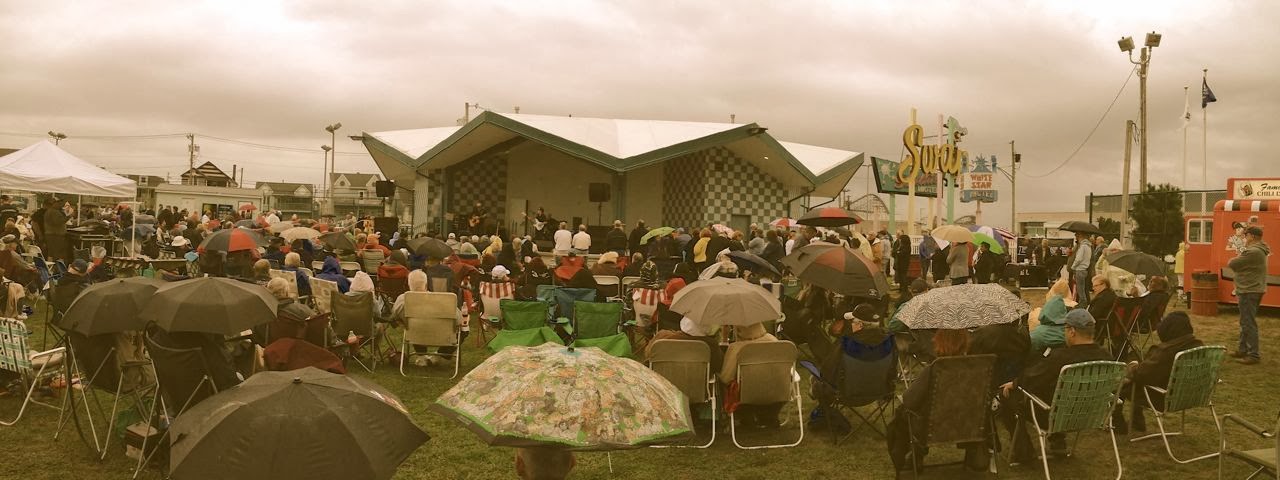
Doo-woppers were enjoying their annual October weekend,
simply opening their umbrellas or ignoring the weather
in a town that continues to make them feel young.
Old cars, old music, old people;
'57 Chevys looking as good as new,
Buddy Holly songs sounding as nice as ever.
Grandpas and grandmas were feeling as spry as kids,
enjoying their Wildwood Days as much now as then.
Saturday, August 24, 2013
Remembering a first, and last
One of the most thoughtful things my mother did for me was take me to my first major league baseball game. It was on August 14, 1965, right around the time of her birthday.
She realized that summer that her two school-age sons had discovered the joys of the American pastime. My brother Lou and I had started collecting baseball cards, watching games on TV, and playing ball with friends in the neighborhood. My mother had acquired an interest in baseball while being raised in Cuba, and was pleased to see her kids doing the same growing up in New York.
The Yankees were hosting the Kansas City Athletics that afternoon. Our family's loyalties were divided between the Mets and Yankees, but the fact the reigning American League champions were hosting a bat giveaway at Yankee Stadium on a Saturday afternoon convinced my mom it was a great opportunity to take me, my brother and Uncle John to live major league baseball.
Until that point, my only images of baseball stadiums were in newspapers, magazines, television and baseball cards -- only the latter in color. You can imagine how awestruck 9-year-old Charlito was ascending the subway station stairs to see The House That Ruth Built in all its splendor in front of him. I was given my first baseball bat, a wooden Hillerich & Bradsby Tom Tresh model, as I passed the turnstile. We found our cheap seats far away from the infield, and I still remember the home run by Roger Repoz, Whitey Ford's good pitching, and the Yankees winning in the bottom of the ninth inning.
Life was never quite the same afterwards. My mother remarried less than two years later, our family moved in late 1967 to Bloomfield, New Jersey, where she raised my younger brother and sister and usually found herself too busy or tired to enjoy live major league baseball. All the while, however, my passion for baseball continued to burn.
In the summer of 2011, with all her kids long grown up and out of the house, my mother surprised us by expressing enthusiasm with the idea of taking a ferry from the Jersey shore to Citi Field to watch the Mets. Our family pounced at the prospect of accompanying her to another major league baseball game.
She enjoyed the ferry ride immensely, marveling at the view of the city from New York Harbor and the East River. After the ferry docked at the marina by Citi Field, my wife, dad and father-in-law made our way with her way slowly by foot to the new Mets ballpark. Unlike my first time at a major league game, I don't remember any particulars from these nine innings. I do recall my mother enjoyed the game from our upper deck seats, and our family accompanied her back to the ferry afterwards for the ride back to the Jersey shore. The day exhausted her, but for months afterwards she kept telling us what a great time she had and how she looked forward to doing it again.
It wasn't to be. My mother passed away the following winter after complications from heart surgery.
Today, on her birthday, I'm remembering fondly the day she took me to my first major league baseball game. I'm also thinking of that late summer day two years ago when I was with her for her last, and wishing she was still with us.
Sunday, August 11, 2013
The bicycle rack
They're built by people in shops around the world,
often by those who use them for daily transportation.
They're shipped to ports in different countries,
and sold in stores in cities, towns and villages.
Some buy them to get to work every day,
others to do their shopping and errands.
Some have them to get serious exercise,
others for leisurely rides through scenic paths.
Bicycles find themselves together in racks
at places like New York City or Long Branch NJ.
They can sit idle for hours or just minutes,
and sprint through traffic or roll slowly by the sea.
Some have thin tires, others fat.
A few have baskets, occasionally a bell.
Some are black, some are white,
they are also red or yellow or pink.
But they're all just bicycles,
sharing space, co-existing on roads,
getting people to work, on errands,
helping some get exercise, have fun.
Labels:
Bicycles,
Long Branch NJ,
New York City,
Pier Village
Subscribe to:
Posts (Atom)